
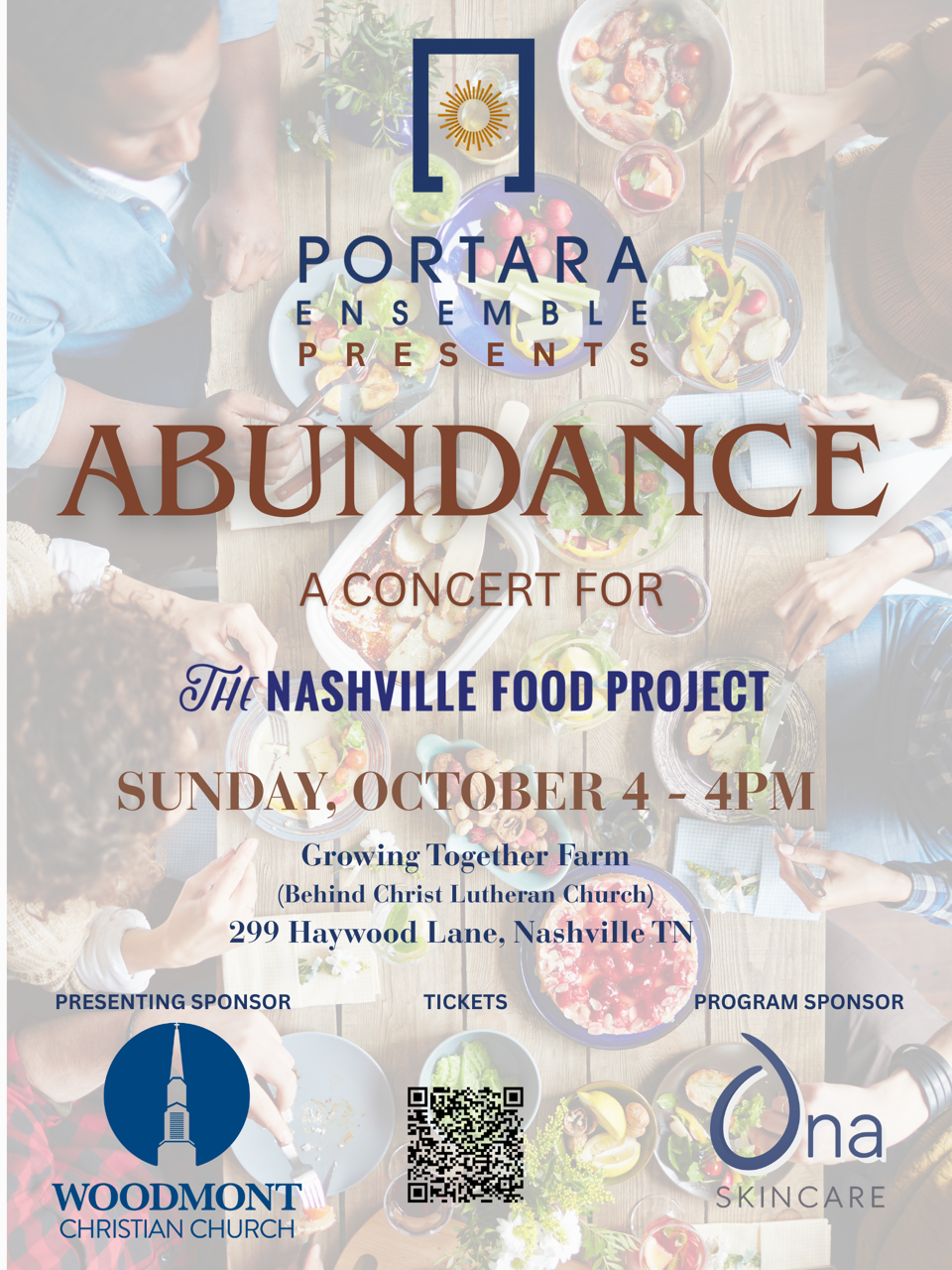
Portara Ensemble Presents: Abundance
SUnday, October 4, 2026
Jason Shelton, Artistic Director
Patrick Dunnevant, Assistant Director
Horacio Guendulain, Accompanist
Welcome to a celebration of the fall harvest in the heart of South Nashville’s community agriculture site - Growing Together Farm. Under a pavilion, surrounded by gardens, this concert will remind us all of the outrageous abundance that we experience when we give and share from the heart. Every dollar from ticket sales will go to the Nashville Food Project, expanding their capacity to alleviate hunger and cultivate community through bringing people together to grow, cook and share nourishing food.
In addition to your ticket, we’re asking patrons to bring Pantry Items from the Nashville Food Project’s donation list.
Thank you to our presenting sponsors for today’s program - Woodmont Christian Church and Ona Skincare. Their generous support doubles the impact of our concert, supporting our capacity to make music which directly supports our community partners.
|
Soprano |
Alto |
|
Janice Butler Amy Darrow Johanna Gomez Valerie Martin Elizabeth Miller Emily Ritter Mary Scheib Erika Taylor Kathryn Wilkening |
Mo Ashwood Elaine Bailey Leigh Ferro Alana Griffith Ericka Gundlach Tanner Lang Molly Lins Lea Maitlen Parvathi Santhosh-Kumar |
|
Tenor |
Bass |
|
Andrew Greene Greg Gunther Zachary Gureasko Christopher Lundgren Brian Marshall Josh Post Dylan Schultz Destin Weishaar |
Matthew Charlton Fernando Castro Patrick Dunnevant Don Hart Tony Jackson Jason Shelton Jordan Simpkins Eric Wiuff |
|
Guests |
| David Davidson, violin |

Program
Conducted by Patrick Dunnevant
Grace (from The Book of Rounds)
Words: Julie Flanders; Music: Emil Adler
arr. Keiji Ishiguri
Underneath My Feet
Words & Music: Jennifer Lucy Cook
Welcome
Jason Shelton, Artistic Director
A Thankful Heart (from The Sacred Harp)
Words: Anne Steele; Music: John T Hocutt
Harvest (The Moon Shines Down)
Words & Music: Jacob Narverud
Partner - The Nashville Food Project
Amanda Richard, Director of Development
Beati Qui Esuriunt
Words: inspired by Matthew 5:6; Music: Hunter T. Johnson
Solo: Greg Gunther
I Hunger and Thirst
Trad. Shaker song; arr. Kevin Siegfried
Solo: Emily Ritter
Partner - Growing Together Farm
Rebecah Boynton, TNFP Community Markets Access Manager
Famine Lament
Trad. Irish melody; arr. David Mooney
David Davidson, violin
Famine Song
Words & Music: VIDA; arr. Matthew Culloton
Solos: Amy Darrow & Mary Scheib
Eden (from The Book of Rounds)
Words: Julie Flanders; Music: Emil Adler
arr. Keiji Ishiguri
Solos: Josh Post & Elizabeth Miller
Abundance
Jason Shelton, Artistic Director
More Than Enough
Words: Wendell Berry; Music: Susan LaBarr
Turn (from The Book of Rounds)
Words: Julie Flanders; Music: Emil Adler
arr. Keiji Ishiguri
Solo: Valerie Martin
Closing
Patrick Dunnevant, Assistant Director
Crowded Table
Words & Music: Natalie Hemby, Lori McKenna, Brandi Carlile; arr. Andrea Ramsey
Solo: Tony Jackson
David Davidson, violin
Program Notes
Grace (from The Book of Rounds)
Words: Julie Flanders; Music: Emil Adler
arr. Keiji Ishiguri
October Project is an American pop rock band based in New York City. The group reached critical and commercial success with their 1990s Epic Records releases October Project and Falling Farther In. In November 2015, October Project released The Book of Rounds, a song cycle of 21 original musical rounds.
Using simple, prayer-like language, the rounds are essentially positive mantras that cascade, circle and relate in the same way the melodies do. The words create layers of affirmation that envelope the participant and offer a compelling journey of transformation and self-reflection. With every repetition, each lyric begins to acquire different shades of meaning, shifting the mind and the heart of the listener.
Julie Flanders, whose deeply influential work in the expressive arts is complemented by her profound work as a healer and spiritual teacher, describes this as one of her most personal projects. The Book of Rounds was originally written for her son as an embrace of protection and comfort during difficult times. When it was finished, Flanders realized that “it was something everyone needed—we all need to receive that kind of love, and we all need to give it.”
Now, in this moment,
It’s time to start over
Open your heart
You know there’s nothing to forgive
Underneath My Feet
Words & Music: Jennifer Lucy Cook
(notes from the composer) Once in a while, usually when I’m overdue for a trip to the grocery store, it dawns on me that there is literally food all over the ground. Like, just growing, for free. Amazing. And those are the times I’m reminded of that gap between our modern world and the natural world, and how healing it can be to take part in nature’s incredible abundance. All we need comes from the earth underneath our feet.
With this in mind, I constructed a text that paints ourselves as runaways seeking refuge from manufactured chaos. In the retreat to nature is the realization that the earth contains the wealth and power we chase and the safety we pursue, as well as the equivalents of our modern household conveniences. By the final verse, there is clarity that the earth provides not only for our physical needs, but also for our emotional and spiritual ones too: “wind will carry my apology and the storm clouds mourn with me while the forest fire clears away all my lingering debris.” I can pinpoint a particular moment in my own life where I hiked to a viewpoint, felt the wind and smelled the pines, watched a circling hawk, and only then could I feel a healing peace clearing away my own lingering debris.
All I need…is underneath my feet
All the wealth is in the flower bed
There is power in the waterfall
And the safety’s in the mountain
For a runaway like me
All I need…is underneath my feet
For the rock is my linoleum
And my icebox is the riverbed
And my ceiling is the canopy
Of a lonely sycamore
All I need…is underneath my feet
Wind will carry my apology
And the storm clouds mourn with me
While the forest fire clears away
All my lingering debris
All I need…is underneath my feet
A Thankful Heart (from The Sacred Harp)
Words: Anne Steele; Music: John T Hocutt
Anne Steele (pen name, Theodosia; 1717 – 1778) was an English Baptist hymnwriter and essayist. For a full century after her death, she filled a larger place in United States and British hymnals than any other woman.
At an early age, Steele showed a taste for literature, and would often entertain her friends with her poetical compositions. She developed a fondness for sacred literature, which led her to compose a considerable number of pieces in prose and verse. These works were published using the pseudonym, "Theodosia." Portions of these spiritual lyrics soon found their way into collections, while the diffidence of the author because of her pen name left her comparatively unknown beyond the circle of her personal friends.
Give me a calm, a thankful heart
From ev’ry murmur free;
The blessing of Thy grace impart,
And make me live to Thee.
Let the sweet hope that Thou art mine
My life and death attend;
Thy presence through my journey shine,
And crown my journey’s end.
Harvest (The Moon Shines Down)
Words & Music: Jacob Narverud
Jacob Narverud (b.1986) is an American choral composer/arranger of Norwegian descent. A native Kansan, Jake is the Founding Artistic Director of the Tallgrass Chamber Choir, an ensemble of musicians from across the Great Plains. Harvest depicts the spirit of the fall season through a series of thoughts on nature and life. The text was inspired by the colors and nostalgia of the Kansas prairie in autumn. Lonely, empty spaces in the fading landscape evoke conflicting feelings of wistfulness and peace--a time to reflect on our present surroundings and the deeper meaning of life itself.
Through the golden haze lie open fields and distant meadows brown,
And deep within a lonely cider grove sits a burning fire,
fading with the leaves,
Bringing warmth to my soul as I surrender to the earth,
embracing all the beauty within.
The autumn wind blows and the moon shines down…
Another day has passed, yet in my restless mind there lies a still reward,
And I’m certain now that I will find my love in harvest.
But still I wonder, oh how I wonder, still, I wonder what will be…
The autumn wind blows and the moon shines down…
Beati Qui Esuriunt
Words: inspired by Matthew 5:6; Music: Hunter T. Johnson
(notes from the composer) Beati Qui Esuriunt is a reflection on hunger. Hunger manifests itself in our lives every single day. Hunger can be physical, emotional, or spiritual. One can hunger for grain the same way they hunger for love. Hunger is felt by people in positions of power and privilege and by those who are marginalized, oppressed, and starved.
This work engages with socio-cultural power structures through the use of Latin and the refraction of compositional styles popular in early church choral music. The relationship between spiritual fulfillment and literal sustenance will present itself differently to every person, much in the same way that hunger itself presents differently to every person.
On a more personal note, I began this work to reflect on my own experiences in eating disorder recovery. I had not felt hunger (a real, physical side-effect of some eating disorders) in years. As I wrote this work, my hunger began to return, and I have truly begun to learn how to fulfill myself.
Beati qui esuriunt panem
esurivi panem
perivi fame
ego implevi me
(Blessed are those who hunger for bread
I was hungry for bread
I was starving
I filled myself)
Blessed are those who hunger
This bread is life
I Hunger and Thirst
Trad. Shaker song; arr. Kevin Siegfried
”I Hunger and Thirst” was written for performance at the Maine Festival of American Music, and premiered at Sabbathday Lake Shaker Village by The Portsmouth Singers, directed by arranger Kevin Siegfried. The unison Shaker song originated at Alfred, Maine in 1837. This arrangement is based on a version of the tune as sung by Sister R. Mildred Barker (1897-1990). The song survives in oral tradition today, and is a favorite of members of the United Society of Shakers at Sabbathday Lake, Maine.
I hunger and thirst, I hunger and thirst after true righteousness;
In what I’ve obtained, in what I’ve obtained my soul cannot rest.
An ocean I see without bottom or shore.
O feed me I’m hungry, enrich me I’m poor.
I will cry unto God, I never will cease,
Till my soul’s filled with love, love, perfect love and sweet peace.
Famine Lament
Trad. Irish melody; arr. David Mooney
"Famine Lament" is also commonly known as "The Praties [potatoes] They Grow Small." This song dates from the Great Hunger (Famine) in the 1840s. Countless Irish died when the potato crop failed several years in a row, which led to a period of mass emigration in search stability.
O the praties they grow small over here, over here,
O the praties they grow small over here.
O the praties they grow small and we dig them in the fall
And we eat them coats and all over here, over here.
O I wish that we were geese night and morn, night and morn,
O I wish that we were geese night and morn.
O I wish that we were geese and could live our lives in peace
Till the hour of our release, eating corn, eating corn.
O we're down into the dust over here, over here,
O we're down into the dust over here, over here,
O we're down into the dust, but the Lord in whom we trust,
Will repay us crumb for crust over here, over here.
Famine Song
Words & Music: VIDA; arr. Matthew Culloton
(notes from composer Moira Smiley) "Famine Song" was written by four young women, collectively known as VIDA. We were learning how women around the world, and through history, work and sing together to pull their families out of hunger and war. It is a song celebrating empathy, lament and the power of singing to pull us together in times of need.
VIDA's Sarah Ferrell was so moved when she learned how the women of Somalia banded together to weave and sell beautiful baskets to feed their families in the catastrophic drought, that she wrote the initial text. Sarah brought the text to VIDA, and through improvisation and songwriting sessions, we discovered how the beautiful laments we were learning from war-torn Bosnia and Serbia seemed to call out in empathy to this Somalian story of sorrow and strength!
Every time we sang it together, we understood the empathic power of song across borders. I hope you enjoy calling for rain - it's a timely prayer for so many!
Ease my spirit, ease my soul
Please free my hands from this barren soil
Ease my mother, ease my child
Earth and sky be reconciled
Rain, rain, rain…
Weave, my mother, weave, my child
Weave your baskets of rushes wild
Weave, my mother, weave, my child
Weave your baskets of rushes wild
Rain, rain, rain…
Out of heat, under sun
Comes the hunger to everyone
Famine’s teeth, famine’s claw
On the sands of Africa
Rain, rain, rain…
Eden (from The Book of Rounds)
Words: Julie Flanders; Music: Emil Adler
arr. Keiji Ishiguri
In this garden
I know who you are
Blood in the dust of a fallen star
If we choose to let go
If we choose to forgive
We can comfort each other
And start to live
More Than Enough
Words: Wendell Berry; Music: Susan LaBarr
Wendell Erdman Berry (August 5, 1934 – August 31, 2026) was an American novelist, poet, essayist, environmental activist, cultural critic and farmer. Closely identified with rural Kentucky, Berry developed many of his agrarian themes in the early essays of The Gift of Good Land (1981) and The Unsettling of America (1977). His attention to the culture and economy of rural communities is also found in the novels and stories of Port William, such as A Place on Earth (1967), Jayber Crow (2000), and That Distant Land (2004).
Berry was an elected member of the Fellowship of Southern Writers, a recipient of the National Humanities Medal, and delivered the Jefferson Lecture for 2012. He was also a 2013 Fellow of the American Academy of Arts and Sciences and, from 2014 to his death, a member of the American Academy of Arts and Letters. Berry was named the recipient of the 2013 Richard C. Holbrooke Distinguished Achievement Award. On January 28, 2015, he became the first living writer to be inducted into the Kentucky Writers Hall of Fame.
The Satisfactions of the Mad Farmer
Growing weather; enough rain;
the cow's udder tight with milk;
the peach tree bent with its yield;
honey golden in the white comb;
the pastures deep in clover and grass,
enough, and more than enough;
the ground, new worked, moist
and yielding underfoot, the feet
comfortable in it as roots;
the early garden: potatoes, onions,
peas, lettuce, spinach, cabbage, carrots,
radishes, marking their straight rows
with green, before the trees are leafed;
raspberries ripe and heavy amid their foliage,
currants shining red in clusters amid their foliage,
strawberries red ripe with the white
flowers still on the vines--picked
with the dew on them, before breakfast;
grape clusters heavy under broad leaves,
powdery bloom on fruit black with sweetness
--an ancient delight, delighting;
the bodies of children, joyful
without dread of their spending,
surprised at nightfall to be weary;
the bodies of women in loose cotton,
cool and closed in the evenings
of summer, like contented houses;
the bodies of men, able in the heat
and sweat and weight and length
of the day's work, eager in their spending,
attending to nightfall, the bodies of women;
sleep after love, dreaming
white lilies blooming
coolly out of the flesh;
after sleep, enablement
to go on with work, morning a clear gift;
the maidenhood of the day,
cobwebs unbroken in the dewy grass;
the work of feeding and clothing and housing,
done with more than enough knowledge
and with more than enough love,
by those who do not have to be told;
any building well built, the rafters
firm to the walls, the walls firm,
the joists without give,
the proportions clear,
the fitting exact, even unseen,
bolts and hinges that turn home
without a jiggle;
any work worthy
of the day's maidenhood;
any man whose words
lead precisely to what exists,
who never stoops to persuasion;
the talk of friends, lightened and cleared
by all that can be assumed;
deer tracks in the wet path,
the deer sprung from them, gone on;
live streams, live shiftings
of the sun in the summer woods;
the great hollow-trunked beech,
a landmark I loved to return to,
its leaves gold-lit on the silver
branches in the fall: blown down
after a hundred years of standing,
a footbridge over the stream;
the quiet in the woods of a summer morning,
the voice of a pewee passing through it
like a tight silver wire;
a little clearing among cedars,
white clover and wild strawberries
beneath an opening to the sky
--heavenly, I thought it,
so perfect; had I foreseen it
I would have desired it
no less than it deserves;
fox tracks in snow, the impact
of lightness upon lightness,
unendingly silent.
What I know of spirit is astir
in the world. The god I have always expected
to appear at the woods' edge, beckoning,
I have always expected to be
a great relisher of this world, its good
grown immortal in his mind.
from The Collected Poems of Wendell Berry, 1957-1982
Turn (from The Book of Rounds)
Words: Julie Flanders; Music: Emil Adler
arr. Keiji Ishiguri
If you need a world to belong to
Look around
You’re already home
And what you seek
You’ve already found
Turn around to me
You will see
No reason to be lonely
Crowded Table
Words & Music: Natalie Hemby, Lori McKenna, Brandi Carlile; arr. Andrea Ramsey
"Crowded Table" is a song recorded by American country music supergroup The Highwomen. It was co-written by group members Brandi Carlile and Natalie Hemby, and singer-songwriter Lori McKenna. Produced by Dave Cobb, the song was released July 26, 2019 as the second single off The Highwomen, the group's debut album. Following by one week the release of the single "Redesigning Women", the song continues the album's theme, calling for community and inclusivity in both country music and society. The song received widespread critical acclaim, winning both the Grammy Award for Best Country Song and the Americana Music Association Song of the Year award for 2020.
You can hold my hand
When you need to let go
I can be your mountain
When you're feeling valley-low
I can be your streetlight
Showing you the way home
You can hold my hand
When you need to let go
I want a house with a crowded table
And a place by the fire for everyone
Let us take on the world while we're young and able
And bring us back together when the day is done
If we want a garden
We're gonna have to sow the seed
Plant a little happiness
Let the roots run deep
If it's love that we give
Then it's love that we reap
If we want a garden
We're gonna have to sow the seed
Yeah I want a house with a crowded table…
The door is always open
Your picture's on my wall
Everyone's a little broken
And everyone belongs
Yeah, everyone belongs
I want a house with a crowded table…